Rare Board Game Reenacts Pilgrimage to Mecca
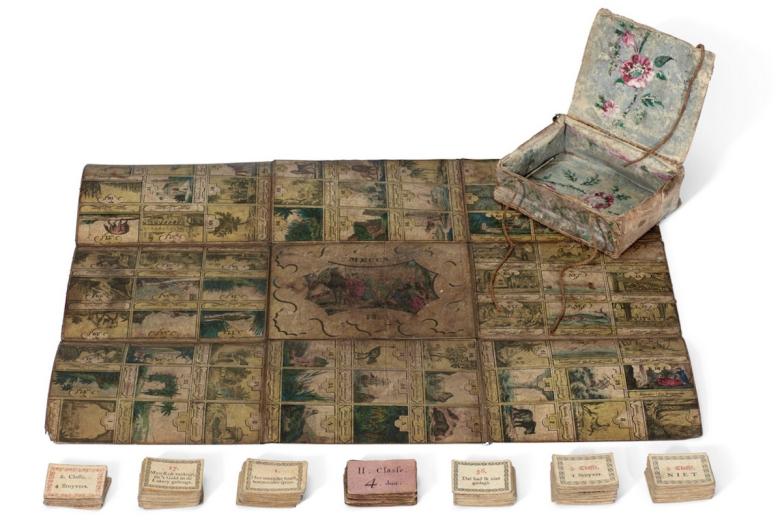



An early nineteenth-century board game that heads to auction in London later this month casts the religious pilgrimage in a playful light. Thought to derive from Germany, the game consists of a folding, linen-backed hand-colored engraving (the ‘board’) on which vivid scenes depict camels, deserts, mosques, and bazaars. Seventy-two numbered squares are marked by captions in German and French. Players roll the dice and move around the spaces in a spiral form, dodging wild animals, shipwrecks, and pirates until they arrive at #73, the center destination: Mecca.
The game, in its original paper-covered box, is a rarity. Sotheby’s says it has been “unable to trace another example.”
The auction estimate is £2,000-3,000 ($2,500+), conservative considering both its scarcity and the newfound appeal of board games in real life and in collecting circles. In our spring issue, columnist Ian McKay reported on the mid-nineteenth-century board game, Game of the Star-Spangled Banner, or Emigrants to the United States, which sold for $4,500 at Forum Auctions in late November. At that same auction, a game by the same maker, Edward Wallis, called New Game of Genius, or Compendium of Inventions connected with the Arts, Sciences and Manufactures was also on offer and sold for $5,000. Another example of that one turned up earlier this summer, again at Forum, selling for $7,620, as did one called the New Game of Wanderers in the Wilderness, which you’ll read more about in our next issue.


![Origen of Alexandria (c. 185–253) Homilia in Genesim, Homiliae in Exodum, in Latin, translation by Rufinus, decorated manuscript on parchment [Austria, Lambach Abbey? c. 1150–1175]. Estimate: $150,000-$200,000.](/sites/default/files/styles/category_card/public/media-images/2026-06/origen.jpeg?itok=0V_4_Lt2)