Manuscript of Songs Written During Charles Wilkes’ Antarctica Expedition Acquired by Library of Congress
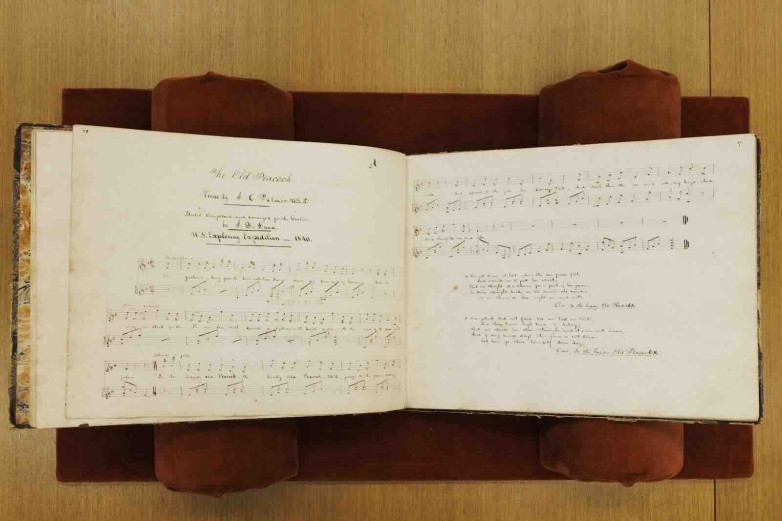
The Old Peacock from the music manuscript of songs written shipboard by James Dwight



A music manuscript of songs written on board ship during the United States Exploring Expedition of 1838-42 captained by U.S. Navy Lt. Charles Wilkes has been acquired by The Library of Congress.
The Ex. Ex. – as the scientific military expedition was informally called – mapped 1,500 miles of Antarctica’s eastern coastline, proving for the first time that the landmass was a continent.
The manuscript, titled The Nativity and other compositions, was handwritten by geologist and mineralogist James Dwight Dana who served on the expedition as one of nine scientists. Dana composed the music and the guitar accompaniments for five of the songs in the volume to poems written by the expedition’s acting surgeon James Croxall Palmer.
The 31-page music manuscript acquired by the Library is bound as a book. When it was first created, it held 56 pages. At some point, 25 pages throughout the book were removed by a previous owner, possibly including the pages with the title composition The Nativity.
These songs composed by Dana and Palmer are the earliest known examples of music and poetry inspired by direct encounters with the Antarctic and include:
- The Old Peacock, written in 1840 to commemorate the U.S.S. Peacock, one of six U.S. Ex. Ex. vessels before it struck the shoals at the mouth of the Oregon Territory’s Columbia River in July 1841 - Dana was on board the ship when it wrecked and had to be rescued with the rest of the crew
- Antarctic Mariner’s Song which features four stanzas from a previous long narrative poem by Palmer called Thulia: a tale of the Antarctic describing the expedition’s travels to the polar south
- David’s Complaint, written near the Oregon Territory in 1841 with words adapted from Bible verses, and musical notations for both a 'Bass Solo' and a 'Chorus of Angels'
- My Tent beside the Oregon – at the top of the first page of this composition Dana noted that the song is “Founded on the following Native Airs of the Oregon Indians,” and includes both 'Chinook' and 'Chekelis' melodies as examples
- Young Shepherds’ Canzonet, a light piece written in the final year of the expedition arranged for a vocal trio of soprano, contralto and bass
Additional songs in the manuscript were composed by others or at other times, including The Birds of Olden Time with music by Dana and lyrics by John O. Colton written at Yale College in 1837. Dana provided guitar arrangements for O Logie of Buchan and John Anderson, my jo, John, two Scottish folk songs, while Palmer “paraphrased” the lyrics to Giovanni Paisiello’s Nel cor più non mi sento (I no longer feel it in my heart) included in the manuscript with a guitar accompaniment by Spanish classical guitarist Fernando Sor.
“This manuscript is a fine addition to the Music Division's collection of unique sources for musical and historical Americana,” Senior Music Specialist Raymond A. White said. “It contains music and lyrics by two significant Americans for whom music and poetry were entirely secondary to their professional careers in science and medicine. We are eager to make this manuscript available to our researchers in the Performing Arts Reading Room.”
The music manuscript joins other holdings in the Library’s collections that tell the story of the U.S. Exploring Expedition including The Charles Wilkes papers, The Dana Family papers, Thulia: a tale of the Antarctic and Antarctic Mariner’s Song by James Croxall Palmer, and photographs of Wilkes, Dana and Palmer.



![Origen of Alexandria (c. 185–253) Homilia in Genesim, Homiliae in Exodum, in Latin, translation by Rufinus, decorated manuscript on parchment [Austria, Lambach Abbey? c. 1150–1175]. Estimate: $150,000-$200,000.](/sites/default/files/styles/category_card/public/media-images/2026-06/origen.jpeg?itok=0V_4_Lt2)