Einstein Relativity Manuscript Letters and Pynson Sarum Missal to Auction
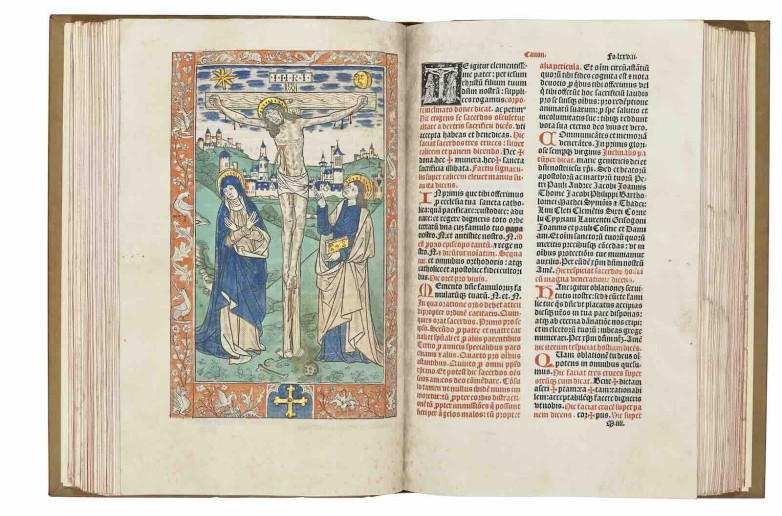
Pynson’s fourth Missal for Sarum use



The July 8 Valuable Books and Manuscripts sale at Christie's will feature a pair of 1912 Albert Einstein letters documenting crucial stages in the development of general relativity, and a vellum copy of Richard Pynson's 1520 Sarum Missal.
The two working letters to Ludwig Hopf (Prague, after February 20 1912, and Zurich, August 16, 1912) were written as Einstein was actively developing his theory, describing it as "stunningly beautiful and amazingly simple" while also wrestling with its unresolved implications (estimate: £100,000-£120,000).
Written in German across four pages and two pages, Einstein writes: "The work on gravitation is going splendidly. Unless I am completely wrong, I have found the most general equations." The February letter to Hopf is rich in scientific content beyond its discussion of general relativity, adding "I derived the laws of photochemical equivalents by way of thermodynamics, without quanta" and also mentioning disputes over alternative theories of gravitation and Edgar Meyer's work on gamma-ray absorption. The shorter letter of August 16 also congratulates Hopf on his marriage.
In the same sale is an exceptional vellum copy of Richard Pynson's 1520 Sarum Missal (London, Richard Pynson, December 24, 1520), one of the rarest survivals of early English printing. Complete copies of Pynson's missals are exceptionally scarce, and no complete vellum copy appears to have come to market for more than a century (estimate £70,000-£100,000).
Although the Sarum Missal was the main liturgical text required for celebrating Mass in most parts of Britain, all but six pre-1534 editions were printed abroad and imported. Of these six editions printed domestically, four were produced by Pynson, his first printed in 1500. Born in Normandy, Pynson arrived in London to work as a bookseller and printer around 1490, and served as official printer under both Henry VII and Henry VIII.
This Missal shows evidence of its survival through the English Reformation, with references to the pope crossed out in accordance with changing religious policy, an d passages relating to Thomas Becket and other Catholic martyrs only lightly censored and remaining legible. The book also preserves unique manuscript records, including a record of the birth of recusant John Gage in 1537.
Other major items in the sale include the 13th century illuminate Clermont-Tonnerre Grail, the French edition of Blaeu’s monumental 12‑volume Grand Atlas, the fine Dogmersfield–Rosebery copy of Hamilton’s Campi Phlegraei, and d’Hancarville’s Collection of Etruscan, Greek and Roman Antiquities.





![Origen of Alexandria (c. 185–253) Homilia in Genesim, Homiliae in Exodum, in Latin, translation by Rufinus, decorated manuscript on parchment [Austria, Lambach Abbey? c. 1150–1175]. Estimate: $150,000-$200,000.](/sites/default/files/styles/category_card/public/media-images/2026-06/origen.jpeg?itok=0V_4_Lt2)